msvcp120.dll Missing? Install the Correct 2013 Runtime in Windows 10 and 11
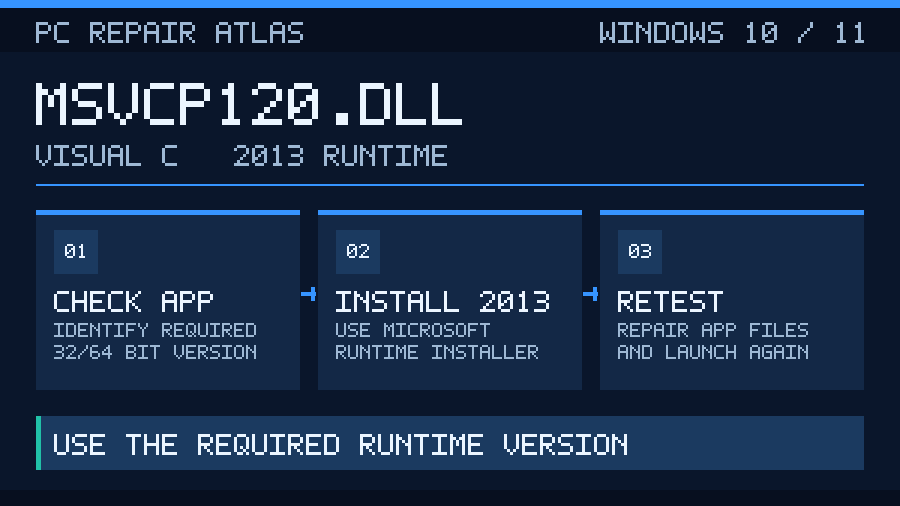
An older desktop application may start with a message that msvcp120.dll cannot be found, especially after moving to a new PC. A related msvcr120.dll message can occur if other parts of the same package are absent.
Start with the exact error and the affected application. Do not install a replacement DLL from a download directory or run registry repair as a substitute for restoring the correct component.
Quick diagnosis: choose the right repair
| What you see | First action |
|---|---|
| Older app on a fresh PC | Install vendor-required 2013 package |
| Both 120 DLLs are missing | Repair the same runtime family |
| Entry point not found | Check app-local library version |
What is msvcp120.dll?
msvcp120.dll belongs to the C++ standard library from the Visual Studio 2013 toolset. Programs using that generation may require the corresponding 2013 redistributable. Its version is distinct from msvcp140.dll, which belongs to the newer v14 family. The modern runtime does not substitute for the older one.
1. Check the exact generation
Write down the number 120 from the message and confirm that the application vendor requires Visual C++ 2013. The 2012 runtime uses 110 filenames and the v14 runtime uses 140 filenames. Installing only the latest redistributable will not satisfy an application that still imports the 2013 names.
2. Install or repair the matching package
Use the software publisher’s prerequisite installer when available. Otherwise find the Visual Studio 2013 section on Microsoft’s redistributable page. Choose x86 for a 32-bit app or x64 for a 64-bit app. An installed package may offer Repair from the classic Programs and Features control panel. Keep other runtime generations installed. Microsoft no longer supports the 2013 toolset, so plan to move to a maintained application version.
3. Verify the original app rather than a DLL checker
Start the original application after the installer completes. Open a small sample or use a built-in test that does not alter important files. If it now reports a different missing DLL, record the new message and consult the vendor instead of downloading a bundle of unknown libraries. If an entry-point error remains, reinstall the application from its authorized source.
If the official installer does not solve the problem
Record whether setup completed, the exact remaining error, and the affected application version. If a second application works, prioritize the original software’s prerequisites and installation rather than making system-wide changes. Windows system-file repair is appropriate only if you also have evidence of damaged Windows components; it is not a reliable way to install a missing optional redistributable. Avoid registry edits, renaming files or running regsvr32 on runtime libraries.
How to verify the repair
- Restart the affected application from its normal shortcut; restart Windows first if an installer or update requests it.
- Repeat the specific task that previously failed, using a test file or disposable save when possible.
- Check whether the original error has disappeared. If a different error appears, capture its full text before attempting another repair.
- Keep a record of the change that worked so you can reverse unrelated changes if necessary.
If an error remains, contact the application publisher with the Windows version, application build, exact error, file path and steps already attempted. Do not include private documents or license keys in diagnostic reports. Windows 10 support and update eligibility vary by edition and servicing program; use a supported configuration where possible.
Frequently asked questions
Is 2015–2022 enough?
No, not for an application specifically linked to msvcp120.dll.
Is the 2013 runtime still supported?
The old toolset is out of support; upgrading the dependent application is preferable.
Can both 2013 and v14 coexist?
Yes. Older runtime generations are commonly installed alongside newer ones.
Related PC Repair Atlas guides
- DLL Errors & Fixes Library
- Fix missing DLL errors in Windows
- Repair Windows system files with SFC and DISM
- MSVCR120.dll troubleshooting